AbbVie's stock has engineered one of the most impressive turnarounds in pharmaceutical history, transforming the loss of Humira into a growth renaissance. This analysis delves into the company's valuation, transformation story, and future prospects.
Current Valuation (September 2025)
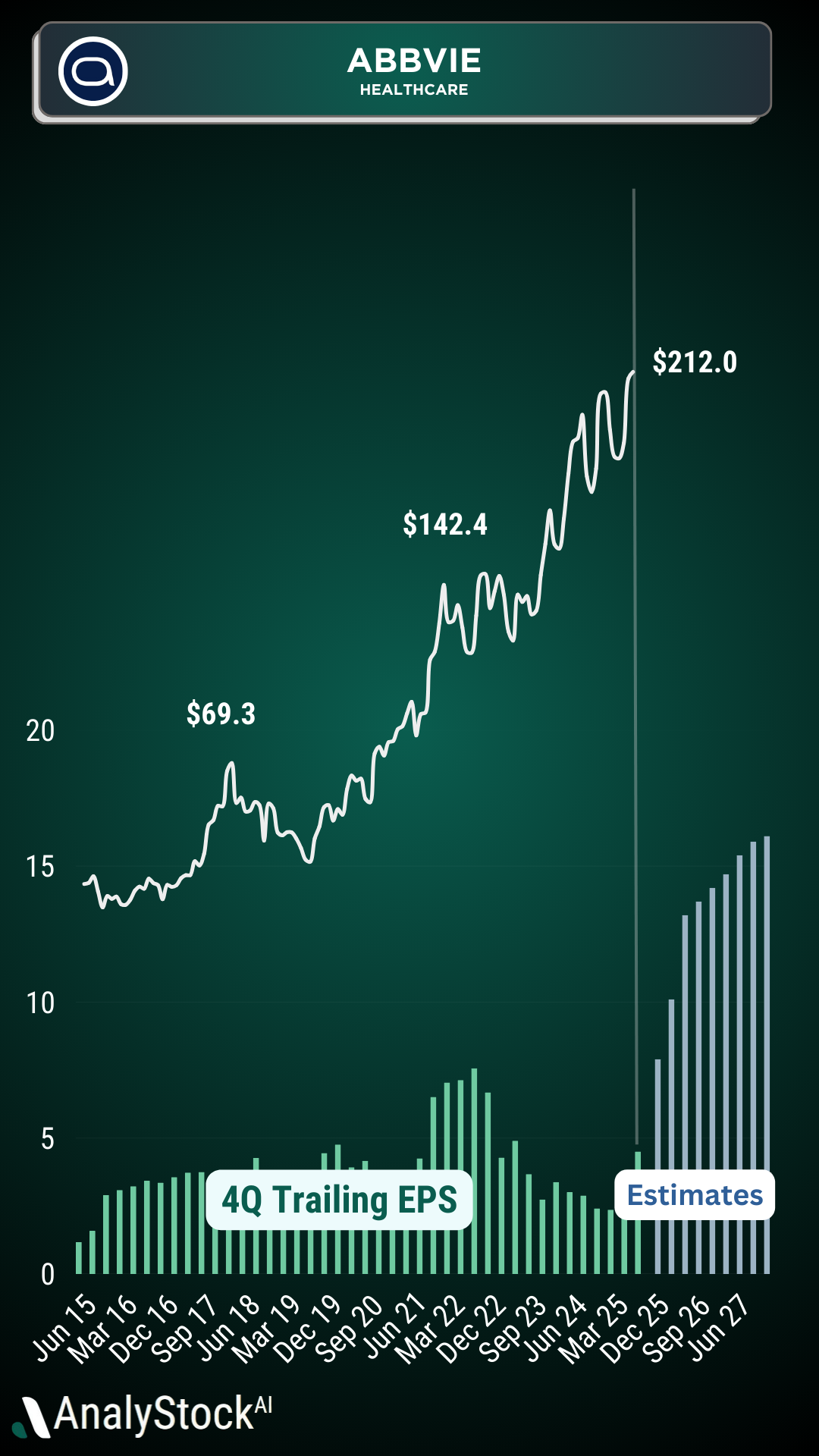
AbbVie commands a market cap of approximately $372 billion, trading around $210 per share. This valuation reflects successful navigation of the patent cliff and growing confidence in the post-Humira era. The company trades at roughly 6.4× trailing sales on TTM revenue of ~$58 billion, sitting above traditional pharma peers but below biotech growth names. On earnings, AbbVie trades at an estimated 17× forward P/E, appreciating the transformation but not yet fully pricing in the immunology potential. With a 3.12% dividend yield, the company offers the rare combination of growth and income.
The Transformation Story
To understand AbbVie's equity story, it's crucial to grasp what Skyrizi and Rinvoq actually treat. Skyrizi targets plaque psoriasis (chronic skin condition), psoriatic arthritis, and Crohn's disease. Rinvoq has an even broader reach, treating rheumatoid arthritis, ulcerative colitis, severe eczema, spinal arthritis, and psoriatic arthritis.
These are chronic autoimmune and inflammatory diseases affecting tens of millions globally. Patients typically need lifelong treatment at $50,000-$100,000+ annually, creating predictable, recurring revenue streams. Both drugs often work when previous treatments like Humira have failed, positioning them as premium therapies in massive, underserved markets with limited competition.
The numbers tell AbbVie's remarkable pivot story. In Q2 2025, Skyrizi sales surged 62% year-over-year to $4.42 billion, while Rinvoq added $2.03 billion with 41% growth. Combined, these drugs have captured ~50% market share in inflammatory bowel disease, demonstrating not just growth but market dominance. This isn't simply replacing Humira - it's building something potentially bigger and more durable across multiple therapeutic areas.
Base Case (12-month view)
Looking to mid-2026, AbbVie should achieve $62-65 billion revenue with continued mid-to-high single-digit growth. As high-margin immunology drugs scale, 2026 EPS could reach $13.50-14.50, building from 2025 guidance of $12.12-12.32.
For a large-cap pharma with this growth profile and 3%+ dividend yield, a reasonable P/E multiple sits at 16-18×, suggesting fair value around $216-261. If Skyrizi/Rinvoq continue exceeding expectations, a premium multiple of 19-20× could push the stock toward $280-300. Downside risks from competition or slower uptake suggest a floor around $190-210.
The base case argues that much of AbbVie's transformation success is recognized, but meaningful upside remains for continued execution.
Bull Case (3-5+ years)
By 2030, analysts forecast $75.4 billion in total revenue, with Skyrizi and Rinvoq accounting for 42% of the mix - transforming AbbVie from Humira-dependent to diversified immunology leader. Patents extending through ~2030 provide a long growth runway without immediate genericization threats.
As high-margin drugs dominate and manufacturing scales, net margins could expand toward 25-30%. On $75-80 billion revenue, this implies $19-24 billion in annual net income. At a market-average 17× P/E multiple, this supports a $340-400 billion market cap, suggesting stock prices of $350-400 (75-90% upside). A premium 20× multiple for immunology leadership could drive prices toward $400-480.
This bull case assumes continued Skyrizi/Rinvoq market share gains, successful pipeline development, geographic expansion, and sustained pricing power - ambitious but achievable given AbbVie's execution track record.
Bear Case
Competitive threats pose the primary downside risk. New therapies could challenge market share gains, patent challenges could accelerate genericization, or pipeline disappointments could create growth gaps. Most concerning would be pricing pressures eroding AbbVie's competitive advantages.
In a pessimistic scenario, revenue might plateau around $60-65 billion by 2030 with compressed margins from pricing competition. Net margins falling to 15-20% would generate just $9-13 billion in annual earnings. At discount multiples of 12-14×, this suggests market caps of $110-180 billion and stock prices of $110-140 (35-50% downside).
This scenario requires significant competitive setbacks and execution failures - possible but unlikely given AbbVie's demonstrated innovation capabilities.
Competitive Positioning
AbbVie's 17× forward P/E with 3.1% yield sits at the high end versus peers like J&J (15× P/E, 3% yield) and Merck (17× P/E, 2.8% yield), but the premium appears justified. AbbVie's growth profile exceeds most traditional pharma companies, its patent cliff navigation demonstrates management excellence, and its immunology franchise provides competitive advantages peers struggle to match.
More importantly, AbbVie achieved something rare: successful pharmaceutical reinvention. Rather than managing decline, the company invested boldly and emerged stronger - execution capability that commands a valuation premium.
Price Target Summary
12-month (September 2026): Base case $240-260, reflecting steady Skyrizi/Rinvoq growth and margin expansion. Upside toward $280-300 if growth accelerates. Downside toward $190-210 from competitive pressures or market headwinds.
3-year (2028): Range of $280-380, with the higher end reflecting successful portfolio diversification and continued immunology leadership. This timeframe allows for pipeline development, geographic expansion, and margin improvement.
Long-term (2030+): Bull case $400-480 assumes sustained immunology leadership and next-generation treatment development. Bear case $110-140 would require competitive displacement and execution failures - unlikely but possible in dynamic pharma markets.
Investment Thesis
AbbVie represents pharmaceutical transformation at its finest. The company navigated an 'impossible' challenge and emerged stronger, with Skyrizi and Rinvoq providing solid growth foundations through the decade while dividends offer attractive income.
At current levels around $210, AbbVie appears fairly valued, with the transformation success largely recognized but meaningful upside remaining for continued execution. The combination of growth potential, dividend income, competitive positioning, and proven management creates a compelling proposition for investors seeking innovative pharma exposure with both growth and income characteristics.
Future performance depends on maintaining competitive advantages, continued innovation, and successfully managing eventual patent cliffs for current blockbusters. Given the company's track record, these challenges appear manageable, though pharmaceutical investing always requires acknowledging inherent risks alongside substantial opportunities.